
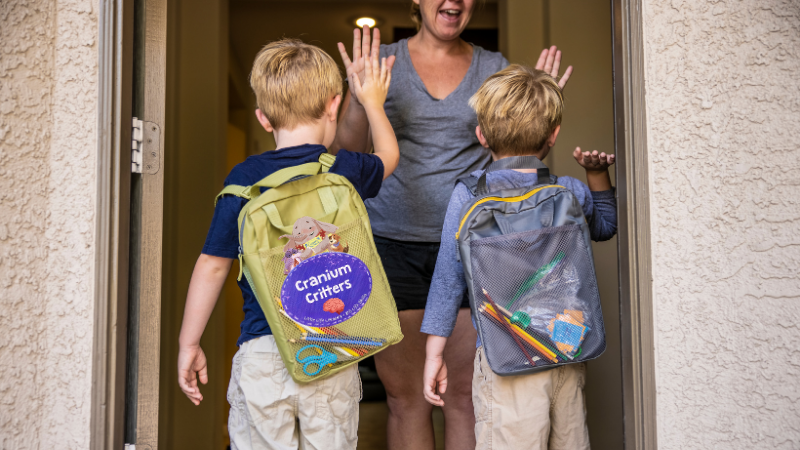
Have you ever looked at a child and thought, You KNOW what you’re supposed to do!
Maybe it’s the student who knows exactly what “ready to learn” looks like but still needs five reminders to get there.
Or the child who can tell you every step of the bedtime routine, but somehow ends up wandering around the house looking for pajamas while getting distracted by three other things along the way.
They know what to do.
So why aren’t they doing it?
Because knowing what to do and being able to do it in the moment are not the same thing.
That’s one of the most helpful things I’ve learned about executive function.
Listen for Einstein’s Helpful Hoots
In the Cranium Critters world, Einstein the Owl represents the prefrontal cortex – our brain’s Head Thinker.
Einstein helps us plan, focus, remember what comes next, solve problems, and think before we act.
He also sends out those little helpful hoots we use to guide ourselves:
- What do I need before I leave the house?
- Finish your math before you start talking to your neighbor.
- Put your folder in your backpack now so you don’t forget it.
- Whoa. Maybe think before you say that!
As adults, we use this kind of self-talk all day long.
Children are still learning how.
Over the years, I’ve learned a great deal about executive function from Sarah Ward, Michelle Garcia Winner, Michael McLeod, and others. Their work has helped me better understand something I saw throughout my years as an educator:
Sometimes children aren’t refusing to do what they know.
They simply aren’t able to do it independently yet.
Sometimes a Child’s Owlet Needs an Adult’s Einstein
Young children have developing Head Thinkers—their Einsteins are still young owlets.
Owlets are learning how to plan, focus, remember what comes next, manage distractions, and think before acting. And while they’re learning, sometimes they need to borrow an adult’s more experienced Einstein.
At school, that might sound like:
- “Get your folder. Turn in your homework. Put away your backpack. Get your pencil. Sit down.”
At home:
- “Put your shoes on. Where’s your backpack? Did you brush your teeth? Get your coat. No, you can’t play with the dog right now. We have to GO!”
Sound familiar?
Of course children need reminders. But if we provide every helpful hoot, whose Einstein is doing all the thinking?
Ours!
The goal is to gradually move those helpful hoots from our Einstein to their growing Einstein owlet.
Give Them a Picture of Success
One of my favorite ways to do this is surprisingly simple: Take a picture.
Years ago, I made social stories for many of my students. Instead of using generic pictures, I photographed the children themselves doing the things we were practicing.
They loved being the stars of their own stories.
Later, through the work of Sarah Ward and others, I learned more about why this can be so helpful. Before we complete a task, our brains often create a mental picture; we imagine what the finished result should look like.
Children may need help developing that picture.
So make it visible.
At school, take a picture of the student:
- sitting at a desk ready to begin
- standing appropriately in line
- completing the morning check-in routine
- showing what a clean desk or cubby looks like
At home, photograph the child:
- ready to leave for school
- with everything needed for soccer practice
- after cleaning up the playroom
- ready for bed
- with a packed backpack by the door
Then, instead of giving five directions, show the picture and say:
- “It’s time for (fill in the blank). Match the picture.”
Now the child can see:
- That’s me.
- I’ve done this before.
- I know what this is supposed to look like.
Short videos can work the same way. I’ve used video self-modeling to help children learn routines such as morning check-in, lining up, and getting ready to go home. Parents could easily do the same with a morning routine, packing a sports bag, feeding a pet, or getting ready for bed.
The Goal Is to Need Us Less
Photos, videos, checklists, timers, and adult reminders are all useful tools.
But they’re scaffolds, not destinations.
We want to gradually step back:
Adult reminds → Child practices → Visual reminder → Child pictures it → Child does it independently
Eventually, the photograph on the refrigerator or classroom wall may no longer be necessary.
The child can picture it mentally.
And instead of waiting for our helpful hoots, their own Einstein begins to speak up:
- What do I need?
- What comes next?
- I’ve done this before.
- I know what to do.
That’s executive function growing right before our eyes.
Little Life Lessons 🧠 BIG Life Skills
Long before I knew terms like executive function and nonverbal working memory, I was taking pictures, making social stories, modeling routines, and helping children talk themselves through problems.
The experts I continue to learn from have helped me understand the brain science behind many of those strategies—and given me new ones to try.
But perhaps the biggest lesson is also one of the simplest:
Our job isn’t to be a child’s Einstein forever.
Sometimes we lend children our Einstein while their own owlets are growing.
Then, little by little, we step back.
And watch them fly!